Global Optimization Portal - Resource | ||
|
The software program developed at GOP is easy to use. The user needs to prepare two input files to run the codes. Three examples are listed below. They are for one dimension, two dimensions and four dimensions. The so-called delta width (Δ) values employed in the examples are calculated by the sample number, domain range values and dimensionality. For every example, default delta width value is calculated and used for each dimension involved.
(1) One dimension (one variable) example: 12 input sample locations in design space and location range is between -10 and +10. They are listed below; 10 , 8.18 , 6.36 , 4.54 , 2.72 , 0.9 , -0.92 , -2.74 , -4.56 , -6.38 , -8.2 , -10 They need to be formatted as, [[10],[8.18],[6.36],[4.54], [2.72],[0.9],[-0.92],[-2.74],[-4.56],[-6.38],[-8.2],[-10] ] in accordance with Javascript format. That is, there are 12 brackets within one large bracket. Each bracket inside gives one location. The target function (which is listed at here) values at these12 input locations are formatted as, [246.9,191.4,143.9,104.6,73.3,50.1,35,27.9,29,38.1,55.3,80.3] There are 12 values,separated by commas, in one bracket. The first value "246.9" is for first location "10" and the last value "80.3" is for the last location "-10". All other values are assigned to locations in accordance with the same order in both lists. (2) Two dimensions (two variables) example: 12 input sample locations in design space and location ranges of both variables are between 0 and +11. They are formatted and listed below; [[0,4],[1,9],[2,1],[3,6], [4,11],[5,3],[6,8],[7,0],[8,5],[9,10],[10,2],[11,7] ] There are 12 brackets within one large bracket. Each bracket inside gives one location consisting of two values. The target function (which is listed at here values at these12 input locations are formatted as, [-31,-37,-20.54,-39.9,-12.48,-27.1,13.1,1.47,2.04,49.44,32.9,66.9] The first value "-31" is for first location "0,4" and the last value "66.9" is for the last location "11,7". All other values are assigned according to their order in the location list. (3) Four dimensions (four variables) example: 72 input sample locations in design space are listed in File A and 72 target function values are listed in File B. Input data format for higher dimensions and sample numbers ought to be generalized in accordance with the format stated above. Using GOP software with the input data listed above, the optimum locations found, together with the initial starting location and the optimization iteration number used, are reported below. For the one-dimension example, two optimization runs are made. the first one with delta=0.53 (default value), the second one with delta=1.5. (The true optimum locaiton is at -3.41 with the function value 27.4.) For the two dimension example stated above, the global minimum is located at (1.74, 6.37). That is, x1=+1.74, x2=+6.37 and the function value is -41.6. The sample data locations and the global minimum are presented in the picture below.  Two optimization runs are made. The first one with delta width=1.01 (default value) and the second one with delta width=1.5. Results are given below. 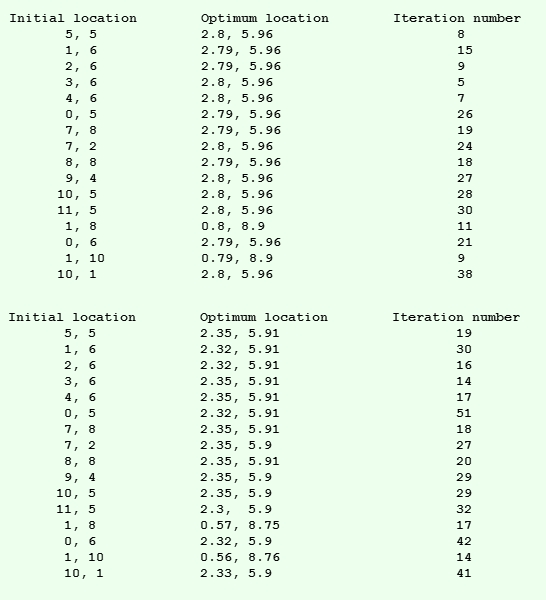 It can be seen that both runs produced two optimum locations. It is straightfoward to use the target function to select the best optimum at (2.3, 5.9). The picture below indicates how the optimization process begins at (10, 1) location and proceeds in design space to the final location at (2.3, 5.9) with 41 iterations/steps. 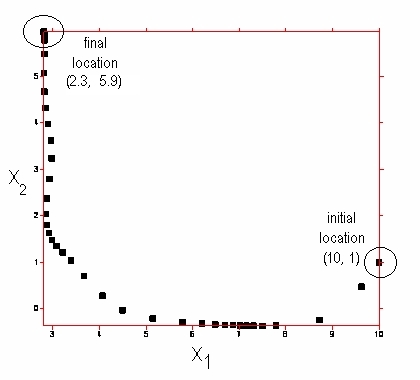 4-dimension test case presented here by using the target function listed in this page. All 4 variables are bounded between -10 and +10. 72 samples are randomly selected by use of Sobol low-discrepancy sequence, together with 72 target function values. The global minimum location is located at (2.5, 2.5, 5.25, -3.5) with the function value -29.8. Two optimization runs are made. The first one with delta width=2.18 (default value) and the second one with delta width=3. Results are shown below. 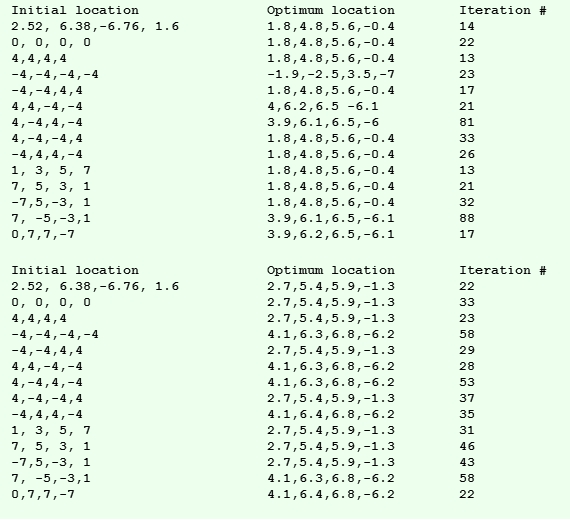 Statistics data of the 4-dimensional input target function values are listed below. Number of sample values 72 Sum 15862.22 Minimum -14.04 Maximum 790 Mean 220.30 Standard deviation 160.30 Two projections from the used Sobol's 4-dimensional 72 locations onto 2-dimensional domain space are presented in the following pictures. As can be seen, sample locations are distributed fairly uniformly across the entire domain (no cluster). 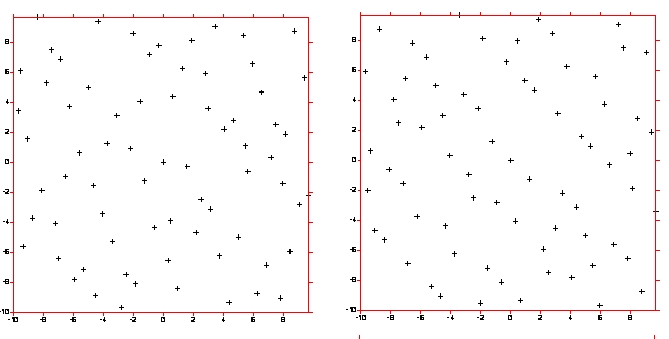 According to the methodology presented in RDIC, the following table presents the default delta (Δ) width values with respect to the sample number and the target function dimensionality. For the hypercube with side length L in m-Dimension, the default delta width can be calculated as follows: N is the number of sample data points, m is the dimension number and the formula is,  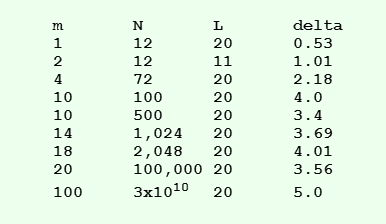 GOP is a by-product of RDIC. The optimum locations found are "local optima". The user needs to examine the results. If two or more local optima are close to one another, then it is likely to have a global optimum among their locations. The following diagrams (close-up views) explain and show what is happening in one dimension using the same target function presented above. Note that the target function is a parabola. 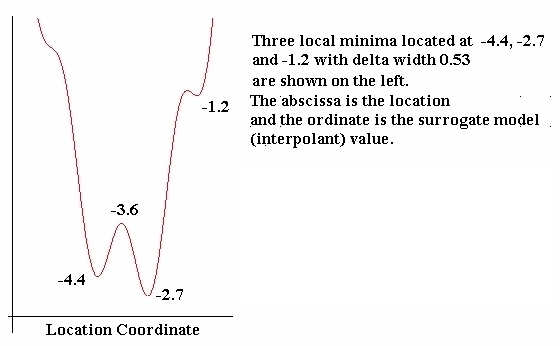  Note that with larger delta width, the optimization run may end up with one local minimum (as reported above for one dimensional case). But in higher dimensions, this minimum may be the wrong global minimum because of the small sample number used and the decreasing interpolant accuracy incurred. It is necessary to select the best answer by evaluating the original target function at the few local minima found, including all the input function values, and then find the global minimum location among them. Recall that GOP methodology is statistical and probabilistic. (More discussion is given in GOP-Algorithm.) Suggestions & Comments:
|
© FANG, INC. 2026 All Rights Reserved
(All information including software provided at GOP should be used by the discretion of the user.
FANG, INC. is not responsible for the outcome of the usage of GOP.)